
A Nadrino from supernova

Hi there! Welcome to my website. I'm a nuclear and particle physicist and a researcher at CNRS. I currently study neutrinos, mainly through the Hyper-Kamiokande experiment in Japan. My expertise includes statistical analysis and software development.

This is my personal website, where I gather useful links and share things I find interesting. On my blog, I write about my work, my thoughts, and what inspires me at a given moment.

Nadrino at the Bourse de Commerce in Paris
This is me :) at the Bourse de Commerce, Paris, 2026.

Code & open-source projects

GitHub

Background & professional connections

LinkedIn

Research & publications

ORCID

Publication highlights

More
Statistical methods · Preprint2026

Flow-Based Surrogates for High-Dimensional Likelihoods in Experimental Neutrino Physics

Precision long-baseline neutrino experiments use near-detector data to constrain systematic uncertainties on the unoscillated neutrino flux, a prerequisite for accurate oscillation parameter measurements at the far detector. When the constrained likelihood is high-dimensional and non-Gaussian, this procedure demands advanced statistical treatment. Here we show that normalizing flows provide faithful and portable likelihood models for this problem. Leveraging an initial Gaussian approximation of the likelihood, we train a hybrid architecture combining coupling transformations and autoregressive spline flows. We demonstrate the method on a representative near-detector likelihood replica with 110 systematic uncertainty parameters, 10 of which explicitly introduce non-Gaussianities in the posterior. The trained model achieves a relative effective sample size of 98%, compared with about 5% for the Gaussian approximation, and reproduces a Markov chain Monte Carlo reference while remaining closed-form, samplable, and pointwise evaluable, making it suited to downstream uncertainty propagation and future near-detector to far-detector fits.
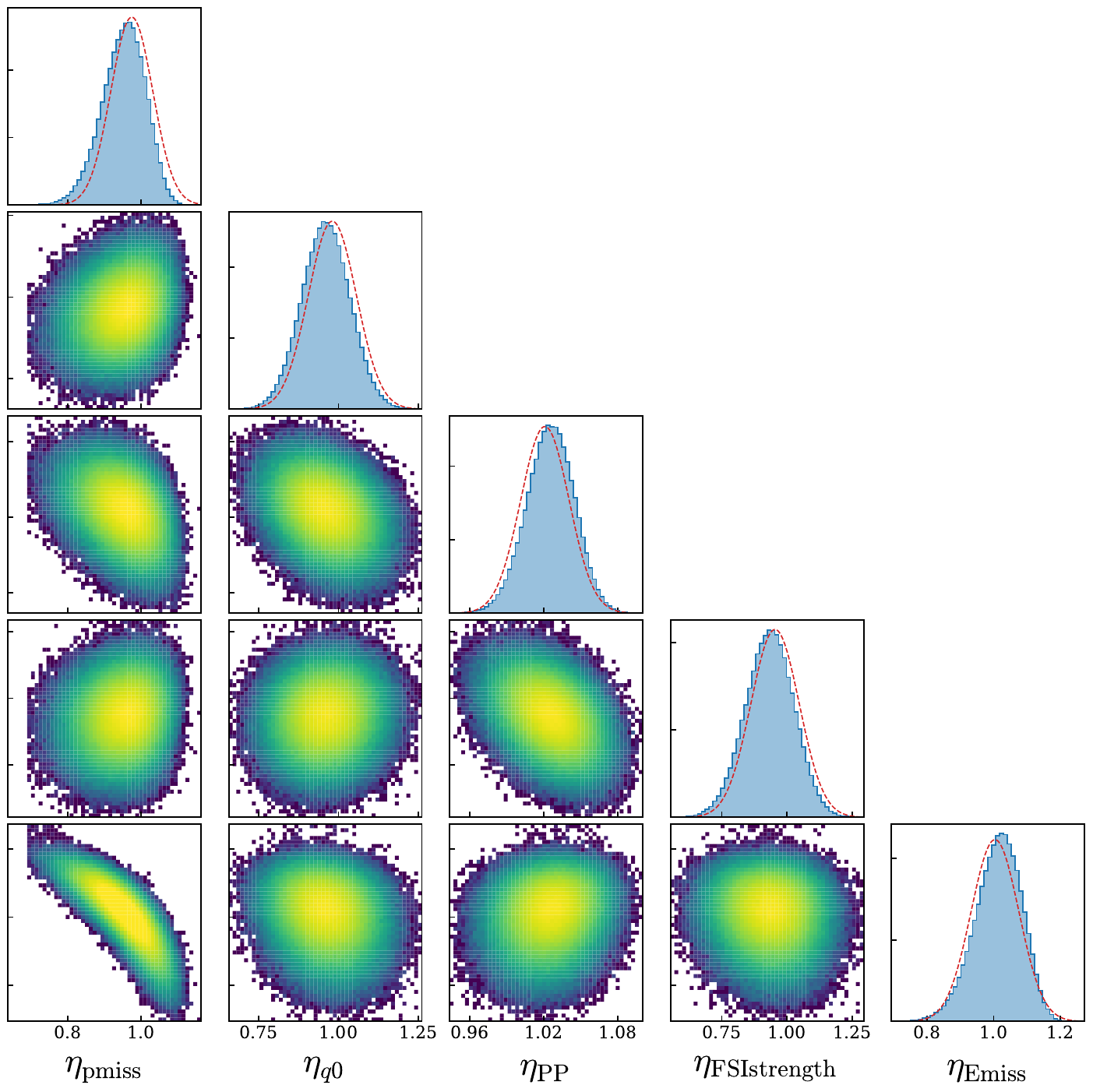
Distributions and correlations of five parameters in a neutrino likelihood model.
nuSCOPE · Preprint2026

A Novel Approach to Short Baseline Oscillation Searches Using Neutrino Tagging with nuSCOPE

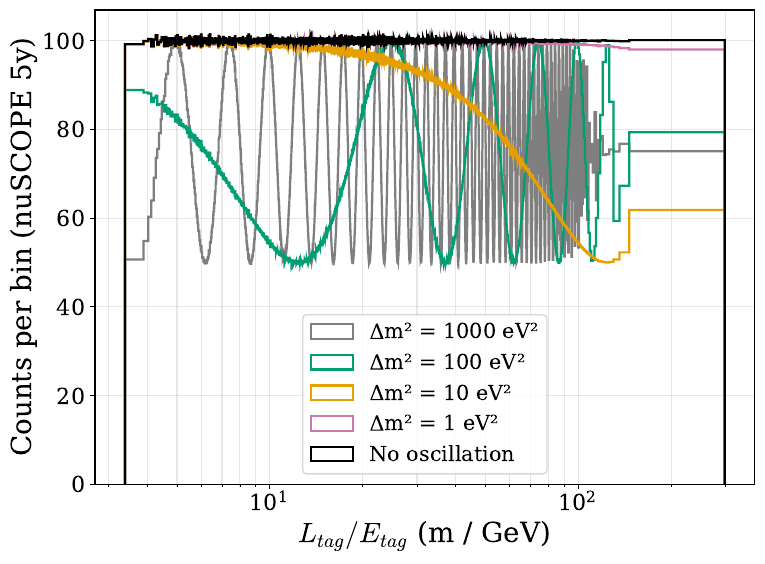
We present the first study of short-baseline neutrino oscillation searches using a tagged neutrino beamline, taking the proposed nuSCOPE facility at CERN as a benchmark. In this Letter we demonstrate that tagged neutrino beams, where the neutrino flavor, energy, and propagation distance are determined with exceptional event-by-event precision, provide a new experimental approach to search for non-standard neutrino oscillations. We evaluate the sensitivity to sterile-neutrino-induced oscillations in the νμ disappearance, $ν_μ\rightarrow ν_e$ appearance, and νe disappearance channels, demonstrating the ability to probe multiple flavor transitions and both appearance and disappearance modes within a single experiment. Our results show that tagged beams enable sensitivity improvements to mass-squared splittings spanning several orders of magnitude while substantially reducing the dependence on neutrino flux predictions that limits conventional searches. We find that nuSCOPE can probe a broad region of parameter space motivated by existing anomalies and extend coverage into previously unexplored territory, demonstrating the strong potential of tagged neutrino beams for precision oscillation physics.

Predicted nuSCOPE event counts for different sterile-neutrino oscillation scenarios.

Software highlights

More on GitHub
C++ · Statistical analysis

GUNDAM

A flexible framework for statistical analysis in neutrino experiments, including cross-section and oscillation studies.

Python · Neutrino oscillations

nu-waves

A Python library for calculating neutrino oscillation probabilities in vacuum and matter, with GPU acceleration.